
SOCIAL
MEDIA
& WEB
My Mission Has Been to Make Social Media The Bark's Priority
Social media is The Bark’s most viewed platform. Not print. Not web. Social media. When I joined the staff, I realized that despite its reach, our social media was not being used to its full potential. Our staff followed a more traditional approach, with a focus predominantly on our print editions.
Yet I couldn't help but consider...we spend hours late into the night laying out our paper, while a single Instagram post can reach far more readers than print.
Print will always be close to our hearts as journalists, but it is time to face the truth. Social media is where the world is. Here is how I'm working to shift The Bark to a social media-forward program.


Social media is real work
One reason our strongest stories and content were not reaching social media was that it felt separate from the core newsroom. It was easy to consider social posts as an outside outlet that did not count toward primary assignments or "real work," making it feel secondary.
To fix this, I clarified that social media counts as an official story by formally adding it to the newsroom matrix with clear guidelines. I also created a visual presentation and shared it with all three Bark class periods to get everyone on the same page.
MATRIX:

PRESENTATION:
Application is no longer available.
Redefining the Social Media Role
In my application for Spring 2026 semester roles, I proposed a revision to our editorial social media position. I met with our adviser to discuss expanding the role into a more social-forward, editorial position. I will be taking on this revised role this semester as Social Media Manager.
In practice, I will work as an editor, collaborating with section editors and reporters to adapt stories for Instagram and TikTok. This will be reflected in a new classwide assignment to create Instagram-style carousels and Teen Vogue and Impact News–inspired multimedia storytelling.
Below is the Social Media role responsibilities outline which I pitched and developed:
Application is no longer available.
Creating new brand templates

When I started as Social Media editor, The Bark Instagram had strong reporting but no shared visual system. Posts looked different depending on who made them, with inconsistent fonts, colors, spacing and tone. Even good stories did not always look connected on the feed. My goal was not to limit creativity, but to make every post immediately recognizable as The Bark. I started by defining clear brand themes tied to purpose, including breaking news, features, opinion, explainers, and newsroom promotions. Each theme followed the same rules for headlines, color use, photo balance, and credit placement.
From there, I built locked Canva templates for each theme, including single posts, carousels, and matching story slides. Fonts, colors, spacing, and credit lines were locked, while editors could update text and photos. Since using these layouts, The Bark Instagram has gained hundreds of followers in one month, with faster posting, fewer revisions, and a feed that reflects the quality of our reporting.
Improving snapshot layout design
I created a presentation on design policy, tips and a guided tutorial for a staff of 100 students. This was to give our Social Media a stronger brand.
Application is no longer available.
AND IT WORKED.
My fellow Barkies were also excited about the social media revamp and were enthusiastic and supportive of the new layouts. One of the core Barkie skills is learning quickly, adapting, and staying up to speed, just as every good journalist does.
I was proud to create a January monthly recap highlighting how well the Bark Instagram performed over the past month.
Application is no longer available.

MY OWN SAMPLES FROM @TheRedwoodBark

MY SNAPSHOTS

To ensure timely coverage, I designed this Canva layout before the walkout. After the event, I rapidly uploaded the news blurb and photo I took, allowing the snapshot to be published about 30 minutes after the walkout.

Beating local news coverage in timing, my post gained hundreds of likes and thousands of views shortly after posting.
*January update: It is currently at 40k views.


The Daily Show interview, built for the feed
I turned my Daily Show interview about reporting in the digital age into a swipeable Instagram post built for scrolling. I broke the conversation into short slides with strong quotes and visuals so readers could grasp the key points without leaving the app.
Before posting, I shared drafts with The Daily Show producers and collaborated with them on edits and final approval. The process made me feel like an insider working alongside a professional media team.
Scroll here:


TAGGING & CO-HOSTING CONTENT WITH USERS
I've pushed for our staff to begin implementing this feature as much as possible. Tagging and co-hosting content with users helps The Bark reach beyond our own followers. When we tag people in posts or co-host content with students, staff or community members, the story shows up on both accounts, not just ours. That means more eyes on our reporting, more shares and more engagement.
EXAMPLES FROM MY WORK:


The results prove the strategy works. While most Bark videos usually get 2–3K views, mine tend to land in the 4–5K+ range. In addition to tagging and co-hosting, I’m intentional about posting at high-traffic times, using lots of close-ups to keep viewers locked in, and keeping videos under 59 seconds so people actually watch to the end.
Making The Bark Instagram visually appealing
As Social Media Manager, I created custom Canva icons for Instagram highlight covers to improve organization, standardized highlight titles for consistency, and added a new highlight archiving print editions from the 2025–26 school year.
Before
After

MY TRANSFORMATION

Before

After

MY TRANSFORMATION


@TheRedwoodBark
For one of The Bark's very first TikToks, I filmed, edited and directed clips from our Bark trip to Northern California Media Day. I used quick cuts, trending audio and brightening tools to make the video feel both informative and fun, while still easy to watch and scroll-friendly.
AS ASSOCIATED STUDENT BODY PRESIDENT, I ALSO RUN...


...our school-affiliated accounts to promote student events, schedule changes and announcements.
STUDENT GOVERNMENT SAMPLES:

MANAGING THE DRAMA CLUB'S SOCIAL MEDIA
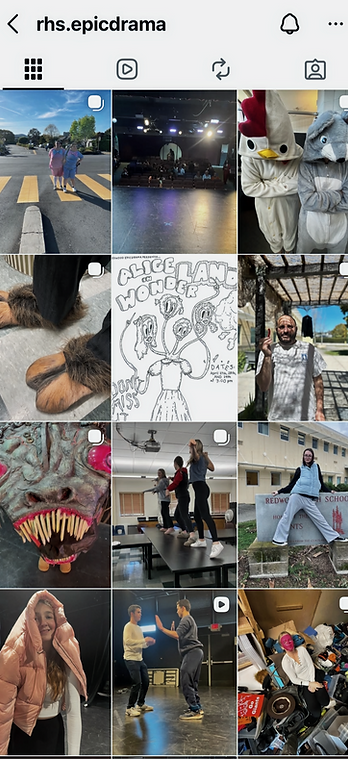
Another account I began running this year is the Redwood High School Ensemble Production Company (EPiC) drama club account on TikTok and Instagram.
I launched an EPiC TikTok account and I revamped the existing Instagram page to make it more professional, creating cast interviews, producing high-quality production photos and designing advertisements to help establish a clear brand and identity for EPiC.
2023
2026
MY TRANSFORMATION

Social Media Literacy Through Feature Reporting

I pitched and co-created a collaborative report from The Bark on the current state of social media. Reporters from different sections of the publication contributed news, features, opinion and multimedia content to cover the topic from multiple angles. The goal of the project is to inform audiences about the exploitation, mental health, body image, trends, political messaging and misinformation on social platforms.
*Awarded #2 Digital Story of the Year at the NSPA National High School Convention.

My feature explores how therapy has become normalized among Generation Z, especially teens and young adults. I conducted a survey through The Bark and found that nearly half of Redwood students have attended therapy. The story notes how social media, especially slogans such as "TherapyTok" have made therapy more normalized for Gen Z and even "trendy."

1. Viewing analytics
This feature allows me to track The Bark’s website traffic, views, most popular content and see when my own pieces are trending.


2. Publishing profiles
Alongside our student Web Designers, I help our staff-in-training (Cub Reporters) set up their official website profiles so they have an established byline to publish under.


3. Laying out stories
Over the past three years, I’ve become fluent in laying out stories in WordPress, which is linked to SNO. I format headlines, decks and bylines, embed images and assign tags/sections to prepare my stories for web publication.

APPLYING WEB CRITIQUE FEEDBACK
As mentioned earlier, I transcribed notes from our website critique roundtable at the JEA/NSPA National High School Journalism Convention. I work closely with The Bark's web and social media team to revisit these notes and bring them back to the class when relevant. View the notes here:


