
LAW, ETHICS
& NEWS LITERACY
Participating in NSPA's 2025 Quiz Bowl

In November 2025, I participated in the Quiz Bowl at the National Scholastic Press Association convention, a competition focused on journalism law, ethics, news literacy, AP style and current events. I was selected by my EIC to compete on a four-person team based on my journalism knowledge and classroom performance. To help our team prepare, I created a Quizlet using 55 key terms and study tips from the Journalism Education Association website.
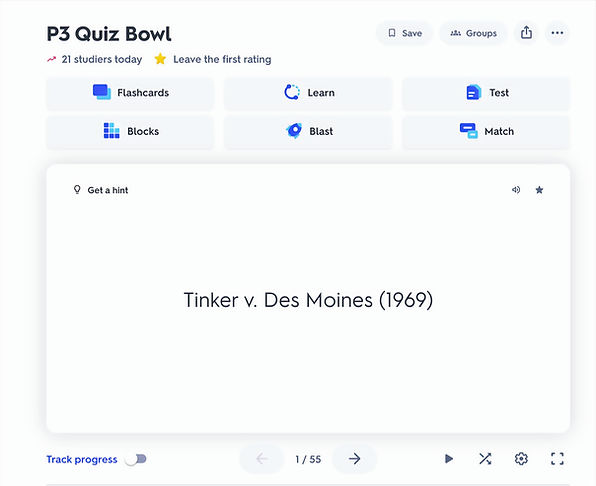
I made this Quizlet in early November for a four-person team. Now, mid-December, the 21 current viewers make me think another classroom is using it as a learning tool!
Building media literacy through updating our curriculum
During my sophomore year, my adviser Erin Schneider included me in updating The Bark’s course structure using a shared 20-page Google Doc. Our class reviewed the draft together and added comments and revisions during class time. I helped reframe the program from “Advanced Journalism” to a CTE-certified "Journalism, Arts and Media" (JAM) sequence.
CTE-certified means the course is part of a Career Technical Education pathway approved by the state.
In practice, that means:
-
The class is designed to teach career-ready, industry-aligned skills
-
It follows state standards for a specific career field (here, Arts, Media and Entertainment)
-
Students gain experience that connects directly to real-world jobs, not just academic theory
-
The course prepares students for postsecondary education and the workforce
Application is no longer available.
Scroll -->
Our Student Journalist Handbook
For access to the full handbook, students refer to their classroom resources. All students complete a handbook quiz with a score of 80 percent or above before publishing each year in the three-year program.
The handbook is updated annually by the incoming EICs with feedback from the student staff. As an editor, I have pitched, co-written and helped revise key policies, including our Death Policy and Artificial Intelligence policy. Contributing to these updates allows me to address current challenges while helping create a strong baseline for future staffs to adapt and build upon.
Application is no longer available.
Scroll -->
Tracking Edits: Ethics, Accuracy and Trust
As Head Copy Editor, I made and presented a tutorial showing staff how to use Version History as a key newsroom tool. I explained how it tracks every change to a story or layout so reporters and editors can check edits, fix mistakes and stay accountable. I also added this responsibility to our newsroom matrix, showed why it matters for fact-checking and plagiarism, and did a live demo so everyone could actually see how it works.

Application is no longer available.
Scroll -->
First Amendment Rights Outside the Newsroom

While covering a student walkout opposing ICE, I focused on supporting my fellow students by giving their voices accurate, timely coverage. Reporting outside the classroom strengthened my understanding of students’ First Amendment rights in real-world situations and the responsibility that comes with covering student activism fairly and thoughtfully.

"PSA" style: Responsible tone & audience awareness
This "Know Your Rights with ICE" post reflects my understanding of news law and ethics by focusing on public-service journalism. Instead of offering opinions or instructions, the graphic links to a credible legal source and provides factual information about constitutional rights. Publishing this piece required careful attention to tone, accuracy and potential harm, especially within a school community.
Application is no longer available.
Reporting on PRESS FREEDOM
...OR LACK THEREOF
NEWS: Gustafson vs SFUSD
I am reporting and writing a news story on Eric Gustafson v. San Francisco Unified School District, a case examining whether a journalism adviser was reassigned in retaliation for student reporting. The story analyzes court proceedings, district responses and broader implications for California student press protections under Education Code 48907.

"They have no authority to reassign a journalism adviser solely for that reason,"
Van Aken wrote.
BACKSTORY
I attended the court hearing on Gustafson’s reassignment with two other Bark editors, an editor in chief from Palo Alto High School and a Palo Alto adviser. We observed the case, spoke with lawyers and exchanged information with journalism educators, including Paul Kandell, a board member of the Journalism Education Association of Northern California, and Tracy Anne Sena, CJE, president-elect, website administrator and honor cord coordinator.


Photo #1 by Tracy Anne Sena
4. January 2026
After the court decision was released, I wrote a news article explaining the outcome and what it meant for student press rights.
LIFESTYLES: Virginia student press victory echoes nationwide
*ONGOING
I co-wrote this story and interviewed Theogony staff members about how Theogony, a student news site in Virginia, pushed back against administrative control and won the Student Press Law Center’s National Courage in Journalism Award after refusing PR oversight and defending student press rights.

"Theogony staff members were told PR representatives must attend all interviews and receive an updated list of in-progress articles...."
THE
BACKSTORY:
1. In July 2025, I met Theogony features editor Nadja Duss at a Boston University journalism program. We bonded over both planning to attend the upcoming NSPA convention and stayed in touch on Instagram.
2. In mid-November, we were both at the National High School Journalism Convention in Nashville. I recognized her when I watched her go onstage to accept the Student Press Law Center’s Courage in Journalism Award.
3. After the ceremony, we started messaging about what had happened at Theogony. She connected me with her EIC so I could learn more.
4. I interviewed both Duss and her EIC and co-wrote a story explaining how Theogony pushed back against administrative interference and defended student press rights.
TAKEAWAY:
This experience showed me that following up matters, and that real journalism comes from listening to real people and real experiences, even from Virginia to California. I’m also grateful for the opportunities I’ve had to make connections and turn them into meaningful stories.

EDITORIAL: Standing strong for student press freedom
This was our senior edition editorial, the most widely read issue of each school year because it’s placed on every seat at graduation. I wrote the editorial with class feedback, and we shaped the piece to focus on defending student press freedom and the responsibility of student journalists to report independently.

"As district leadership changes, Bark welcomes Dr. Courtney Goode to assume the superintendent position, effective July 1, and expects that he will continue to protect the student press rights and uphold the standards to protect student expression and adviser security..."
INVESTIGATIVE DOCUMENTARY: What happened to Novato High School's newspaper?
For “What Happened to the Novato High School Newspaper?”, I did follow-up reporting focused on news ethics and media literacy. I read the Smith v. Novato Unified School System court decision and studied California Education Code 48907 to understand student press rights. I checked timelines using archived newspapers and school records, interviewed former student journalists across the country over Zoom, and traveled an hour away to interview a journalism adviser in person. This project shows how press law, verification and context matter in student journalism.
“Be ready for feedback. You can’t hide. There’s your byline. You’ve got to be fearless and strong.”
EDITORIAL: America’s freedom of speech is on mute
This editorial looks at how freedom of speech is being threatened in the U.S., using recent events like the assassination of Charlie Kirk and the temporary suspension of Jimmy Kimmel Live! to show how speech can be silenced. As a staff, we worked through how social media reactions, political bias and online pile-ons can make free speech feel risky instead of protected.

“Free speech is a right that must be upheld at all times, not just when it suits one’s opinion..."
